A Certificate of Analysis is only useful if you know how to read it. Here is a field-by-field walkthrough of HPLC and LC-MS data on a research peptide COA.
A Certificate of Analysis (COA) is the single most important document accompanying a research peptide. It is the analytical evidence that the vial contains the labelled molecule, at a stated purity, with a defined salt form. Reading a COA correctly means understanding what each analytical method is actually measuring — and, just as importantly, what it is not measuring.
The two core analytical methods
High-Performance Liquid Chromatography (HPLC)
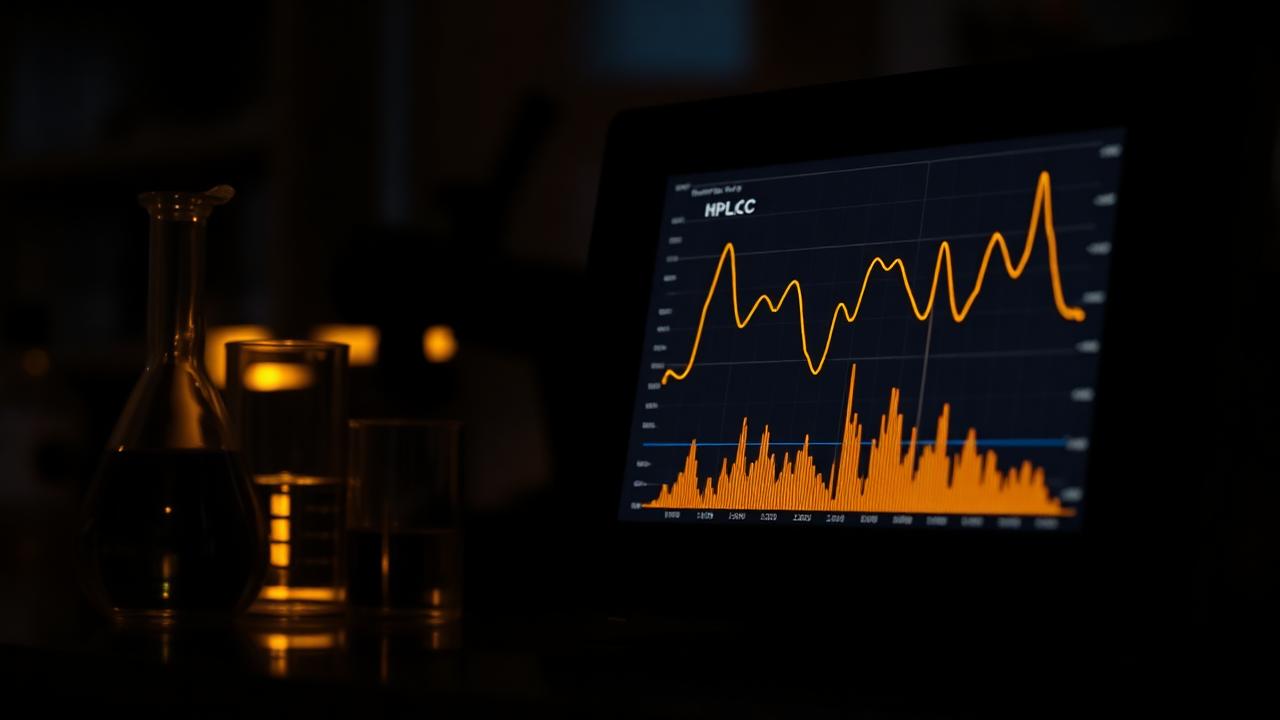
Reverse-phase HPLC separates molecules by hydrophobicity as they pass through a packed column under solvent gradient. The output is a chromatogram: a plot of detector absorbance (typically UV at 214 nm or 220 nm, where peptide bonds absorb strongly) against retention time. The area under the main peak, expressed as a percentage of total peak area, is the reported HPLC purity figure. This number tells you how much of the sample is the primary compound relative to synthesis by-products such as truncated sequences, deletion sequences, or oxidised residues — but it does not by itself confirm the identity of that main peak.
Liquid Chromatography–Mass Spectrometry (LC-MS)
LC-MS couples the same chromatographic separation to a mass spectrometer, which measures the mass-to-charge ratio of ionised molecules eluting from the column. This is the identity check: the observed mass is compared against the theoretical monoisotopic or average mass calculated from the peptide's amino-acid sequence. A COA should state both the observed mass and the acceptable deviation window, typically ±0.5 Da for peptides under roughly 5,000 Da.
COA field-by-field reference
| Field | What it should report | Why it matters |
|---|---|---|
| Batch / lot number | A unique identifier tied to a specific production run | Enables traceability if a query arises about a specific vial |
| Synthesis / release date | Date the batch was manufactured and QC-released | Anchors any stability or shelf-life documentation |
| HPLC purity (%) | Peak-area percentage of the main compound | Quantifies synthesis by-product load |
| Analytical method | Column type, mobile phase, gradient and wavelength | Lets a lab reproduce or sanity-check the method |
| LC-MS observed mass | Mass within stated tolerance of theoretical | Confirms molecular identity, not just purity |
| Counterion identity | Acetate or trifluoroacetate (TFA) | Affects true peptide content by mass |
| Counterion content (%) | Percentage of total vial mass attributable to salt | Needed to calculate actual peptide mass in a vial |
| Water content | Karl Fischer titration or TGA result | Residual moisture affects long-term stability |
Understanding counterion content
Synthetic peptides are typically isolated as a salt — most commonly an acetate or trifluoroacetate (TFA) salt — because the purification process (preparative HPLC using a TFA-containing mobile phase, or ion exchange for acetate) leaves the peptide bound to counterions. A vial labelled '5 mg peptide, TFA salt, 15% counterion content' contains less than 5 mg of the actual peptide chain by mass once the counterion fraction is accounted for. Any COA that omits counterion data makes it impossible to calculate true peptide content.
Red flags to check for on any COA
- A purity percentage with no accompanying chromatogram image to verify it against.
- A stated mass with no LC-MS trace supporting the figure.
- No counterion identity or content reported anywhere on the document.
- Identical batch numbers reused across what are claimed to be separate shipments.
- Blend or combination products reporting a single combined purity figure rather than per-component data.
- No stated RUO (research-use-only) classification on the document itself.
How to cross-check a COA against a physical vial
- Confirm the batch number printed on the vial label matches the batch number on the COA exactly.
- Check the stated net mass on the vial against the COA's declared fill weight.
- Compare the molecular formula and mass on the COA against an independent reference for the named peptide.
- Where a supplier offers third-party verification, request the underlying raw chromatogram rather than a summary figure alone.
How Origin Labs documents every batch
- Every batch shipped by Origin Labs New Zealand includes a lot-specific COA covering every field above.
- HPLC chromatogram and LC-MS trace images are provided alongside the summary figures.
- Third-party analytical verification is available on request for any batch.
- RUO classification is stated explicitly on the COA and the vial label.
Frequently asked questions
What HPLC purity is considered standard for research-grade peptides?
Typically ≥98% is considered standard, with peptides under roughly 30 residues frequently specified at ≥99% given their more straightforward synthesis profile.
Does HPLC purity alone confirm a peptide's identity?
No. HPLC purity confirms how clean the main peak is relative to by-products, but only LC-MS mass confirmation verifies that the main peak is actually the intended molecule.
Why does counterion content matter for research calculations?
The counterion (acetate or TFA) contributes to the total vial mass without being part of the active peptide chain, so omitting it makes it impossible to calculate the true peptide mass available for a study.
What does an acceptable LC-MS mass tolerance look like?
For most research peptides under roughly 5,000 Da, an observed mass within ±0.5 Da of the theoretical mass is considered an acceptable identity match.