Lyophilised peptides are chemically stable but handling errors during reconstitution are the single largest source of degraded research material. Here is the reference.
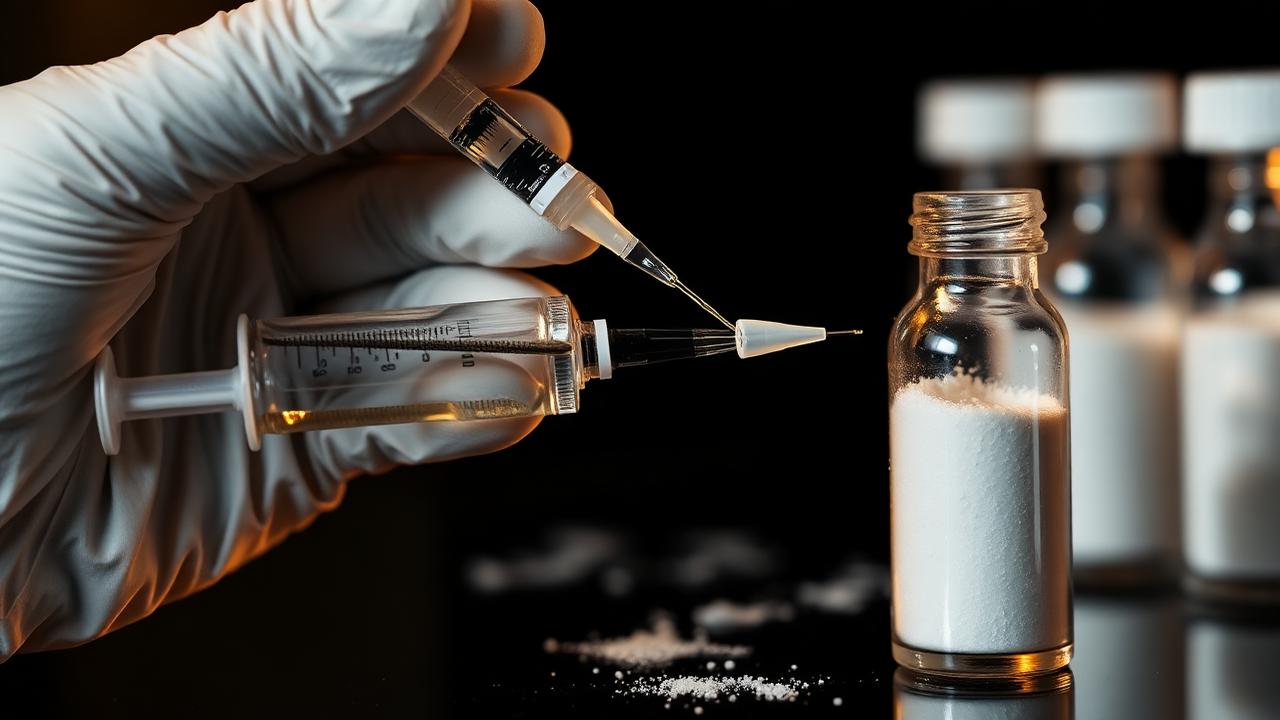
Lyophilisation (freeze-drying) removes water from a peptide solution under vacuum, leaving a dry, porous cake that is dramatically more stable than the equivalent liquid formulation. Most research peptides supplied as lyophilised powder will remain stable for extended periods when stored correctly. The reconstitution step — returning that dry material to solution — is where most avoidable degradation and handling errors occur in a laboratory setting.
Why lyophilised peptides are more stable than liquid formulations
Peptide degradation pathways — hydrolysis of amide bonds, deamidation of asparagine and glutamine residues, oxidation of methionine and cysteine, and aggregation — are all water-dependent or water-accelerated processes. Removing free water via lyophilisation slows these pathways by orders of magnitude, which is why dry powder is the standard long-term storage format for research peptides rather than pre-dissolved solution.
Storage conditions before reconstitution
- Store lyophilised vials at -20°C for long-term storage, or 2–8°C for shorter-term use, according to the supplier's stability data.
- Protect vials from light — many peptides, particularly those containing tryptophan or methionine, are photosensitive.
- Keep desiccated where possible; humidity is a primary driver of cake collapse and moisture-accelerated degradation.
- Allow a vial to reach room temperature before opening to minimise condensation forming inside the vial.
Solvent selection for reconstitution
| Solvent | Typical use case | Consideration |
|---|---|---|
| Sterile water for injection | General-purpose reconstitution for most research peptides | No preservative; solution should be used promptly or stored per protocol |
| Bacteriostatic water | Reconstitution where a preservative (benzyl alcohol) is compatible with the study | Extends usable window; not compatible with all cell-culture applications |
| Acetic acid solution (dilute) | Peptides with poor aqueous solubility at neutral pH | Used to improve solubility of certain basic or hydrophobic sequences |
| DMSO (research-grade) | Very hydrophobic peptides or where aqueous solubility is inadequate | Requires downstream dilution compatibility checks for the assay in use |
Reconstitution technique
- Bring both the lyophilised vial and the diluent to room temperature before combining.
- Direct the stream of diluent gently down the interior wall of the vial rather than directly onto the powder cake.
- Allow the vial to sit undisturbed for a short period to let the solvent begin dissolving the cake passively.
- Gently swirl rather than shake — vigorous agitation introduces air and can promote aggregation or denaturation at the air-liquid interface.
- Inspect visually for complete dissolution; any visible particulate should be treated as a handling or solubility issue, not disregarded.
Common handling errors
- Vigorous shaking or vortexing, which introduces foam and interfacial denaturation.
- Reconstituting directly from freezer-cold vials, causing localised condensation and uneven dissolution.
- Using solvent volumes that create concentrations exceeding the peptide's solubility limit, causing precipitation.
- Repeated freeze-thaw cycling of reconstituted solution, which accelerates aggregation.
- Storing reconstituted solution at room temperature for longer than the stability window justifies for the study design.
Post-reconstitution stability considerations
Once in solution, a peptide is subject to the full range of water-dependent degradation pathways. Reconstituted solutions are generally handled as short-use working stocks, refrigerated between uses, and disposed of according to the receiving laboratory's own SOPs rather than stored indefinitely. Any research protocol should define its own acceptance criteria for reconstituted-solution shelf life based on the specific peptide's known stability profile.
Frequently asked questions
Why is lyophilised powder more stable than pre-dissolved peptide solution?
Most peptide degradation pathways such as hydrolysis, deamidation and oxidation are water-dependent, so removing free water through lyophilisation slows these processes substantially.
Should a lyophilised vial be shaken to reconstitute it?
No. Gentle swirling is preferred; vigorous shaking introduces air and can denature the peptide at the air-liquid interface.
What solvent is typically used for general-purpose peptide reconstitution?
Sterile water for injection is the most common general-purpose diluent, with bacteriostatic water, dilute acetic acid or DMSO used for specific solubility or study requirements.
Does Origin Labs provide handling guidance with its peptide shipments?
Yes. Reconstitution and storage reference information is provided alongside the COA for every batch shipped by Origin Labs New Zealand.